In a period of fast change, uncertainty has become the norm. Technological improvements, geopolitical movements, and socioeconomic variations shape the terrain of our planet, bringing equal parts difficulties and possibilities. In this setting, education is critical to preparing pupils for the uncertainties of the future. Critical thinking is one of the most important talents required to flourish in such an environment. This article investigates the importance of critical thinking abilities in International Baccalaureate (IB) education at the best schools in Gurgaon, delving into how these skills are developed and the broader implications for students navigating the complexity of the twenty-first century.
Understanding Critical Thinking
Critical thinking is more than a catchphrase; it is a fundamental talent that supports intellectual exploration and problem resolution. Critical thinking is fundamentally defined as the ability to assess, evaluate, and synthesise information to create reasoned judgements and make appropriate decisions. It takes more than just mindless memorisation or repetition of data; it also includes critically engaging with ideas, asking probing questions, and challenging assumptions.
Adapting to a Changing World
The world today is complex, ambiguous, and rapidly changing. Our concerns are numerous and interwoven, ranging from climate change to technological disruption, global pandemics, and sociopolitical upheaval. In such a changing setting, critical thinking skills are essential. IB education understands this reality and focuses a major emphasis on developing students’ critical thinking skills. Students at IB School learn to address problems analytically and creatively by interacting with other viewpoints, questioning assumptions, and analysing evidence.
Encouraging Inquiry-Based Learning
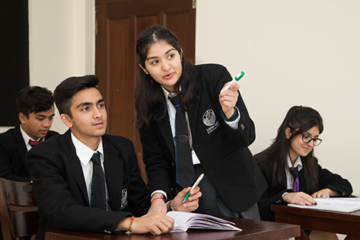
One of the defining features of IB education in Gurgaon schools is a focus on inquiry-based learning. Rather than passively collecting knowledge, students are encouraged to actively engage with it by asking relevant questions, seeking evidence-based answers, and building their understanding of the world. This strategy not only expands students’ knowledge but also improves their critical thinking skills. IB school programmes create a spirit of intellectual inquiry by encouraging students to study things independently and reach their conclusions, preparing them to deal with uncertainty.
Developing Analytical Skills Across Disciplines
Critical thinking is not limited to a single subject but rather a transdisciplinary skill that pervades all areas of learning. Whether studying mathematics, physics, humanities, or the arts, students at the best IB school in Gurgaon are forced to think critically and analytically. They learn how to recognise patterns, analyse arguments, and weigh different viewpoints. By honing their analytical skills across subjects, IB students build a varied toolkit that allows them to approach challenging problems from numerous perspectives.
Cultivating Open-Mindedness and Empathy
In addition to analytical skills, IB education emphasises the value of open-mindedness and empathy. In a society marked by cultural diversity and interdependence, the ability to empathise with others and comprehend opposing ideas is critical. IB students are taught to evaluate diverse points of view, respect cultural differences, and recognise the intricacies of global issues. IB programmes emphasise empathy and open-mindedness, developing not merely critical thinkers but also responsible global citizens.
IB students learn about people’s experiences and viewpoints from many cultures and backgrounds by studying literature, history, and social sciences. They learn to value the breadth of human variation and the connection of global challenges. This exposure helps pupils develop empathy and compassion, allowing them to interact with others courteously and productively.
Preparing for Higher Education and Beyond
IB education develops abilities that are useful not only in the classroom but also in higher education and future employment. Colleges and colleges are increasingly looking for students who can think critically, communicate effectively, and adapt to new problems. IB graduates, with their rigorous academic preparation and emphasis on critical thinking, are well-prepared to succeed in further education and beyond. Whether they pursue higher education or enter the workforce, IB alumni have the intellectual agility and resilience required to flourish in an uncertain world.
Graduates from IB schools in Gurgaon are distinguished in college and university settings by their ability to think freely, interact with difficult concepts, and solve issues creatively. They are used to rigorous academic study and flourish in settings that encourage intellectual curiosity and critical thinking.
Any excellent IB school in Gurgaon recognises the importance of critical thinking abilities and works to develop them in pupils. Best IB School programmes in Gurgaon educate students about the challenges of the twenty-first century by encouraging inquiry-based learning, strengthening analytical abilities across disciplines, and promoting open-mindedness and empathy. As we face an uncertain future, critical thinking in IB education remains crucial in directing students down a path of lifelong learning and intellectual growth.